Anyone who likes to cook meat should have a stab at making beef Wellington at least once in their lives. It’s a technical recipe, yes, with a number of elements involved in pulling it all together, but the payoff - should you accept the challenge – is well worth the effort.
Ingredients 25
For The Beef Wellington
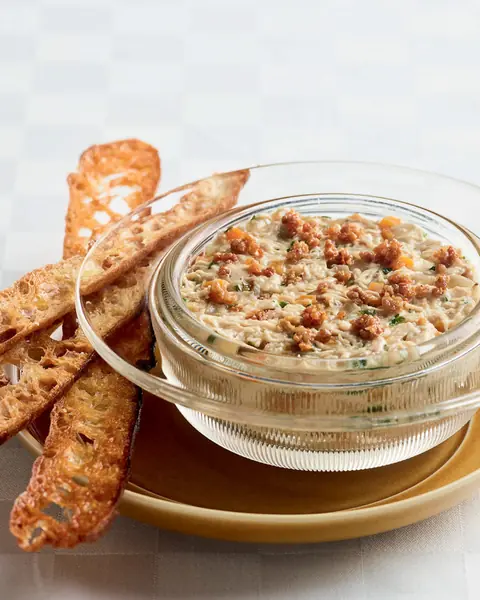
Duck Liver And Foie Gras Parfait
Savoury Crepes Makes 3
Duxelles
Your new home
for cooking
Turn your recipe chaos into a plan for the week.
Browse 1000+ inspiring creator recipes
Unlimited recipe import from social media, blogs and more
Generate shopping lists and meal plans in seconds with AI
Method 15
To Make The Duck Liver Parfait
In a large saucepan over a medium heat, combine the , and . Cook gently for about 30–40 minutes, stirring occasionally, until most of the liquid has reduced. Remove from the heat and set aside.
Preheat the oven to 110°C (230°F).
Warm the in a small saucepan over a low heat for 15 minutes or until 40°C (105°F).
Place the and foie gras, if using, in a food processor and blend for 2 minutes or until smooth. Add the and , then blend for 2 minutes. Add the shallot reduction and , then blend for 1 minute. With the processor running, slowly pour in three-quarters of the warm and blend until combined. Slowly add the remaining warm butter and blend for a further 2–3 minutes or until smooth.
Strain through a fine sieve into a pouring jug and allow to cool slightly. Pour into 3 small to medium-sized ramekins or jars then place them onto a deep baking tray and cook for 10 minutes. Transfer straight to the fridge to chill. The parfait will keep in the fridge for 1 week.
To Make The Savoury Crepes
Put all the ingredients except the olive oil in a blender. Blend for 1 minute or until the mixture is smooth and has no lumps.
Heat half the in a 28 cm (11 in) non-stick frying pan. Add one-third of the crepe mixture, tilting the pan so the mixture covers the base, and cook for 20–30 seconds, then flip and cook for a further 20–30 seconds. Repeat with remaining oil and crepe mixture. Set aside to cool.
To Make The Duxelles
Cook the and in a saucepan over a medium heat for 1–2 minutes. Add the and cook until reduced by half. Add the and and cook, stirring frequently, for 20–30 minutes or until the mushrooms are almost broken down to a paste and the liquid has all but reduced. Season with , transfer to a food processor and pulse a few times so that the mixture becomes more paste-like.
To Prepare The Beef Wellington
Brush the with oil and season with salt. Heat a large frying pan over a high heat and brown the beef all over. Transfer to the fridge to cool.
Lay out three savoury crepes next to each other, slightly overlapping, then use a spoon to spread over a thin layer of the . Then apply about a 3 mm-thick coating of the duck liver parfait over the top of the duxelles. Refrigerate any remaining parfait for another use.
Brush the cooled all over with . Place the beef in the centre of the crepes and roll up and over the beef, tucking the sides in as you roll.
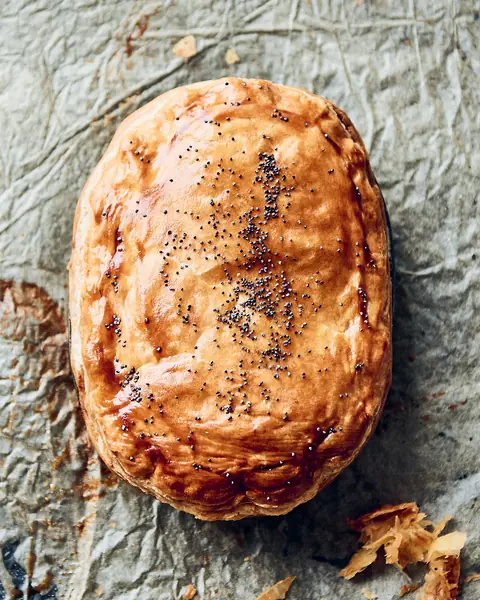
If using a block of pastry roll out a 40 cm × 40 cm (15 ¾ in) sheet of or lay out your pre-rolled sheets, then brush all over with . Place the in the middle of the pastry. Fold in the sides (they should only come in about 4 cm (approx. ¼ in) on the beef), then roll over from the closest point to you to enclose the beef. Once you have made a nice even cylinder roll of pastry, cut away any excess. Brush the whole wellington with egg yolk and transfer to the fridge to cool for 1 hour.
Preheat the oven to 200°C (390°F).
Combine the , , and . Place the wellington onto a baking tray lined with baking paper. Brush again with and sprinkle liberally, all over, with the seeds and a sprinkle of salt.
Cook for 40 minutes, or until the internal temperature reaches approximately 48°C (120°F), then rest for 20 minutes. Resting is important as the residual heat will keep it cooking to reach an internal temperature of approximately 54–57°C (130–135°F), which will stop the juices coming out of the beef when you carve.

Meatsmith's tips
We suggest serving the beef wellington with our Bordelaise sauce recipe.