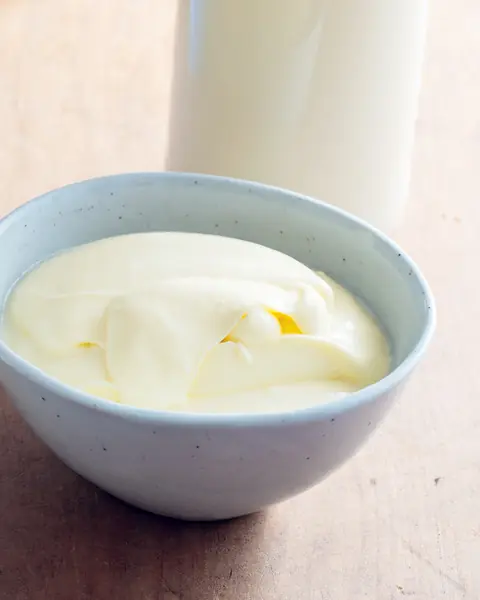
Yoghurt is so easy to buy, so why bother making your own? Well, if you’re like me, sometimes you just want to understand how things are made and either use that information to make your own for special occasions, or make it a part of your weekly routine.
There are times when I make yoghurt regularly and times when I just have some nice milk that I know I won’t be able to finish and I’ll turn it into yoghurt, which lasts much longer. The truth is, though, however much you do or don’t eat yoghurt, there are a number of uses for good yoghurt and it’s a great thing to have in the fridge. It also couldn’t be simpler to make. The hardest part is figuring out the right incubation chamber to hold your milk as it is fermenting. All you’re really doing is heating milk, cooling it down, adding a bit of live active yoghurt, then maintaining it at a specific temperature for a minimum of 5 hours, or much longer if you prefer a very sour flavour (I like to ferment mine for 12–14 hours).
Either way, holding the yoghurt at this temperature is pretty crucial. You are creating a good environment where healthy or good bacteria can thrive and reproduce. This prevents bad or unhealthy bacteria from growing and spoiling your milk. Once you find the right yoghurt starter and an incubation chamber that works for you, you should be able to get consistent results. Don’t be discouraged if your first batch doesn’t work out, however. Sometimes they just don’t set, or you need to play with your set-up a little.
Makes 1 kg (2 lb 3 oz).
Ingredients 2
Your new home
for cooking
Turn your recipe chaos into a plan for the week.
Browse 1000+ inspiring creator recipes
Unlimited recipe import from social media, blogs and more
Generate shopping lists and meal plans in seconds with AI
Method 6
Slowly heat your in a saucepan over a low heat until it reaches 82°C (180°F). Whisk it every few minutes to make sure it doesn’t catch and burn on the bottom.
When it reaches 82°C (180°F), turn the heat off and remove from the stove. You can place your pot directly in an ice bath and whisk until the temperature reaches somewhere between 43–46°C (109–115°F). Alternatively, you can let this cool on its own on your benchtop, just be aware this takes surprisingly long.
While your is cooling, prepare your incubation chamber (see my tips below) by prewarming it.
Place your in a small bowl and, when the temperature of the has dropped, ladle a small amount into the bowl and whisk it, then add this back to the rest of the milk and whisk to combine.
At this stage, either pour into jars or cover your bowl with plastic wrap. Incubate at a temperature between 43–46°C (109–115°F) for a minimum of 5 hours. You can also do this overnight or even longer, it will just get a bit sourer.
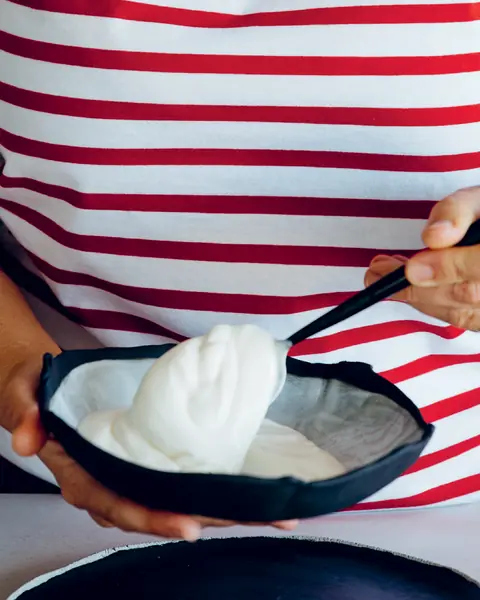
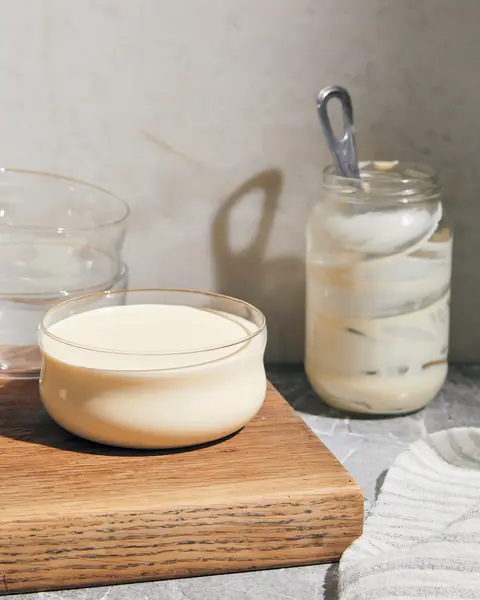
Next, place the in the fridge for about 8 hours to ensure it is completely set. At this point, it is ready to eat. You can also carefully and gently strain the yoghurt through a fine-mesh sieve for a further 8 hours in the fridge, to get a thicker, Greek-style consistency.

Danielle Alvarez's tips
A few options for incubation chambers:
- Set your mixed yoghurt in a covered bowl or jar inside a larger bowl of hot water. Place the whole thing in a super low oven or an oven that has a pilot light.
- Place your mixed yoghurt inside a thermos or jars and place that in a cooler filled with other jars of hot water or a couple of hot water bottles.
- Place your yoghurt in jars and wrap them with a heated blanket.
- Place your yoghurt in jars and place the jars in a crock pot or slow cooker on the lowest setting. Add enough hot water to come three-quarters of the way up the jars and place a lid on the pot. Incubate overnight.