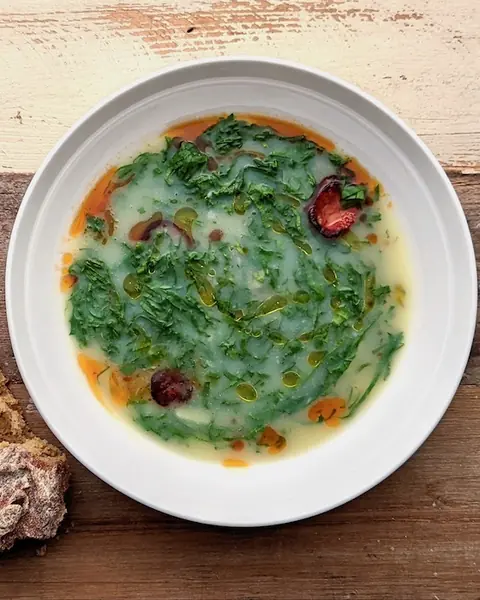
This version of acquacotta comes from Viterbo, an ancient Etruscan town of Lazio, halfway between Capalbio (on the border of Tuscany) and Rome. The star ingredient here is the wild chicory, which lends an irreplaceable flavour to this dish – one of very pleasant bitterness (which sounds like an oxymoron but once you taste it, you’ll see what I mean). It grows in curly mounds of jagged-edged weeds and can be collected around the surrounding countryside in the spring before they flower, often together with other wild vegetables and greens, such as stinging nettles, dandelions, sow thistle, wild beet, wild fennel and wild asparagus.
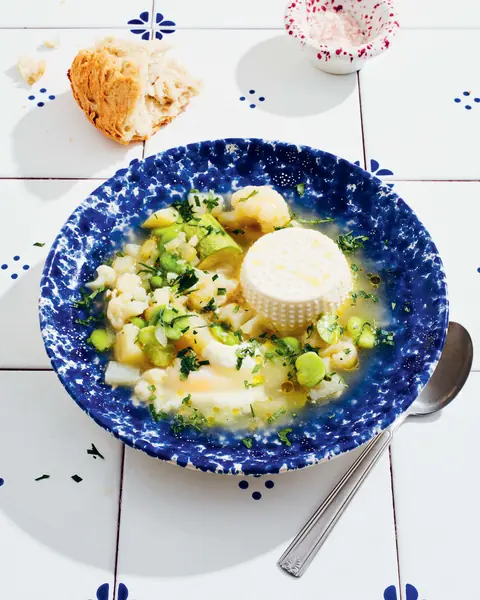
The characteristic of this Viterbo-style acquacotta is that the vegetables and aromatics are cooked entirely in water, not sizzled in olive oil. It’s a wonderfully simple dish of clean flavours, where tufts of strong, bitter wild chicory sing out in contrast to the creamy, mellow egg yolk and fruity raw olive oil. I think it’s perfect as is, but a traditional variation is to add pork sausage, crumbled into the soup after removing the casing.
To serve the acquacotta, the vegetables and accompanying broth are spooned over a slice of stale bread, which soaks up any liquid like a sponge. If you haven’t got stale bread handy, dry out some slices of fresh crusty bread in a low oven. Choose a delicious, well-structured bread – it makes all the difference here. Remember that the dish should not be at all ‘soupy’. In fact, any liquid that has not been soaked up by the bread should be removed, as it would interfere with the final touch: some extra-virgin olive oil, drizzled over the top.
Ingredients 10
Your new home
for cooking
Turn your recipe chaos into a plan for the week.
Browse 1000+ inspiring creator recipes
Unlimited recipe import from social media, blogs and more
Generate shopping lists and meal plans in seconds with AI
Method 6
Carefully wash the wild greens several times over or until all the dirt has been removed (if particularly dirty you can leave them to soak in a bowl of first). Wild chicory should have its root stubs scraped well or cut off and any wilting leaves picked off. If they are particularly tough or large, you may need to chop roughly and give them some extra cooking time by blanching them first until tender. If they are young and small, then just use them as they are, in their tufts.
Put the , , and wild greens in a large saucepan and pour in the . Season with a good pinch of salt and place over low–medium heat. Bring to a simmer, stirring occasionally to distribute the vegetables evenly (the greens will wilt down soon enough). Cook for approximately 10–12 minutes, or until the vegetables are tender. Taste the broth to check for seasoning and add salt and pepper as needed.
In the meantime, prepare the – if using fresh bread, dry the slices out in a low oven until dry to the touch but not coloured (this is just like toasting but you want them to still be pale, so as not to affect the taste).
Crack the into the simmering soup and cover with a lid until the whites are cooked but the yolks are still runny, about 2 minutes. Remove from the heat.
Place a slice of in each shallow bowl and ladle over some soup topped with one . Let it rest for a minute before serving so that the bread can soak up the broth. Ideally, the bread should soak everything up and there should be no liquid in the bowl. If the bread is still dry in places, ladle over some extra broth from the pot. If there is any extra liquid present in the bowl, remove it with a spoon or some paper towel.
Finish with a drizzle of very good olive oil and a generous handful of chopped and calamint.

Emiko Davies's tips
If you don’t have wild chicory, you could use silverbeet (Swiss chard), though it won’t have that same characteristic flavour. Other substitutes include watercress, dandelion greens and English spinach. If you don’t have fresh wild herbs like wild fennel and calamint, try feathery fennel tops (instead of the wild fennel) and oregano, marjoram, thyme or mint (instead of the calamint).